

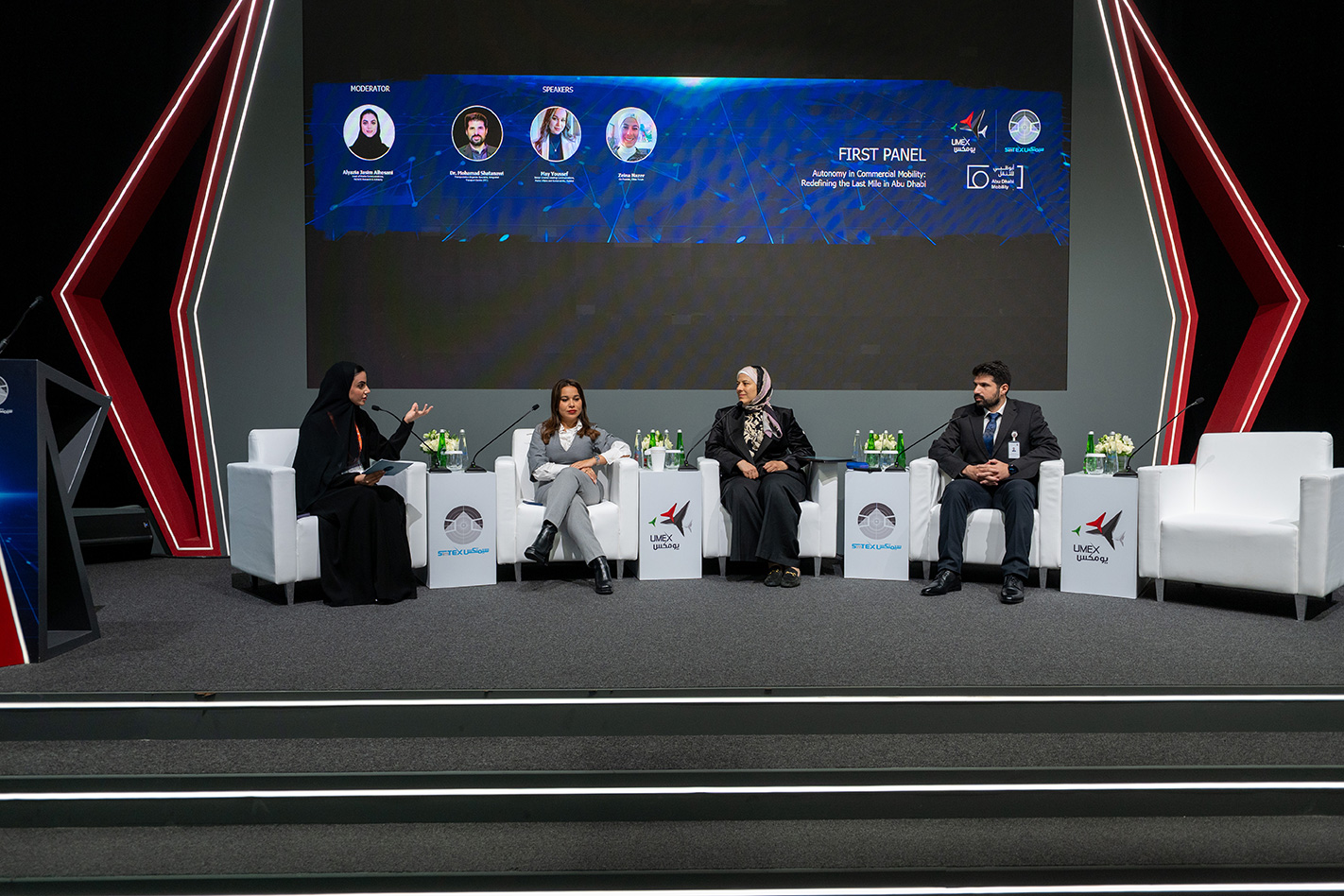
Abu Dhabi 23 January 2026: Taking place for the first time at the Unmanned Systems Exhibition (UMEX) and Simulation and Training Exhibition (SimTEX), the Future of Autonomy X ITC provided insights into commercial and civilian applications of autonomous technology. Under the conference theme “Transforming Industries through Autonomy,” the two days of sessions highlighted a common message that innovation flourishes when advanced technology is paired with clear governance, coordinated ecosystems and a strong focus on safety.
Sessions provided a dynamic platform for industry leaders and technology experts to exchange perspectives and engage in meaningful dialogue on the future of autonomy across key commercial and civil sectors, from urban management to transport, logistics, utilities, inspection, and waste management, through an extensive programme of panel discussions and hands-on workshops.
Panel Session: Autonomous Systems and the Smart City Economy
The panel discussion, titled “Autonomous Systems and the Smart City Economy,” examined the transformative potential of autonomous vehicles (AVs) and unmanned technologies in enhancing the efficiency, safety, and sustainability of public and private transport systems.
The panel featured a line-up of distinguished thought leaders and technology experts, including Jason Lee, Vice President – Mobility Portfolio Management at Space42; Eyad Abdulla, Head of ICT at Masdar City; and Stephane Timpano, CEO of ASPIRE and A2RL, and was moderated by Dr. Mohamed Jama Mohamed, Director of Transportation at WSP.
Opening the discussion, Timpano highlighted the profound social and economic impact of mobility. “If mobility is not well managed, then you have an impact on the cost of living of the people and the cost of management of the city,” he said, emphasising that autonomous mobility can significantly elevate the quality of life for citizens.
On his part, Lee highlighted the vast opportunities offered by autonomous systems across various domains. “We are entering a new era of innovation with the [advent] of autonomous mobility,” he said, pointing to the unprecedented efficiencies autonomous solutions are bringing to different industry sectors, from last-mile delivery to inspection and infrastructure monitoring, all while reducing risk and improving overall safety.
Drawing a real-world example of the impact of autonomous systems, Abdulla stated: “Masdar City is a living example of an autonomous and sustainable city.”
He traced the city’s journey from its pioneering Personal Rapid Transit (PRT) system in 2010, which reduced emissions by 40%, to the recent deployment of a fourth-generation autonomous shuttle.
Delving into the key factors shaping the growth and expansion of autonomous systems, the panellists agreed that scaling autonomous technologies hinges on both economic viability and public trust, emphasising Abu Dhabi’s potential to set global benchmarks for autonomous urban systems.
“Abu Dhabi has become one of the top three testbeds [globally] and the biggest in the region when we talk about autonomy,” Timpano observed, stressing the need to build public trust, secure the required certification, advance interoperability and enhance resilience against cyber attacks, to ensure safe deployment and operation of AVs and autonomous systems.
To achieve this, the panellists stressed the need for a robust certification system, strategic investments in infrastructure, fostering close collaboration between regulators and industry stakeholders, and staying agile as technology and standards evolve.
In closing, the panellists agreed that building public trust is the single most important step for the next five years, likening the adoption of autonomous vehicles to the early days of commercial aviation, and envisioning a future with fewer private cars, where residents rely on safe, clean, and affordable autonomous transport.
Panel Session: Drones in Aquaculture - Transforming Fish Feeding Operations
The first panel, “Drones in Aquaculture: Transforming Fish Feeding Operations,” explored how unmanned aerial systems are changing the economics and safety of fish farming. Ulrich Weckx, Chief Executive Officer of Eanan, described how traditional feeding methods relied on boats, crews and manual labour, often constrained by distance and weather conditions. Drone-based feeding, he explained, allows operators to reach fish cages faster and feed with greater precision.
“Drones make feeding faster, more precise and better controlled,” Mr. Weckx said, noting that consistent feeding plays a direct role in fish health, stress levels and biomass growth. He emphasised that the technology is not simply about efficiency gains, but about improving overall productivity while reducing environmental impact. Reflecting on the Dalma Island pilot, he said the project demonstrated how drones could be integrated into everyday operations rather than remaining a standalone technical trial. The aim, he added, was “to increase the biomass of the fish through regular and precise feeding, while also making operations more environmentally friendly.”
Hamad Al Ansari, Section Head - Aquaculture at the Environment Agency Abu Dhabi (EAD), highlighted the importance of feeding efficiency, stressing that feed accounts for 60 to 70 percent of aquaculture operating costs. He described the drone trials as “an achievement,” while stressing the need for longer testing periods and robust data to benchmark performance against manual feeding. Mr. Al Ansari highlighted the potential to integrate drones with AI-driven monitoring tools such as underwater cameras and water-quality sensors, enabling adaptive feeding based on real-time conditions. Reducing human exposure at sea, he added, was “a very good addition to the project.”
Panel Session: Commercial UAV Operations – Requirements, Procedures & Awareness
The second panel, “Commercial UAV Operations - Requirements, Procedures & Awareness,” shifted the focus to urban applications and regulatory readiness. Tobia Fletcher, CEO of Teyar Cleaning Services, explained how UAV infrastructure and procedures are already being put in place to support city-scale services. “The ecosystem is really getting ready for use-based integration and digitalisation,” he said, describing how drone-enabled façade cleaning removes the need for workers to operate at height, significantly reducing risk.
“At the moment we are focusing on façade cleaning, which obviously eliminates the need for workers at a height,” Mr. Fletcher said, adding that future plans include emergency response applications such as firefighting support.
He emphasised that drones should be viewed as an extension of existing services rather than a replacement. “I wouldn’t say it’s changing it entirely; it’s more integrating and assisting with the existing system,” he noted, pointing to faster response times and the ability to bypass traffic congestion as key advantages.
Mouza Al Sawafi, Section Head of UAV Operations at the Integrated Transport Centre (ITC), outlined the regulatory foundations enabling such applications. She explained that operators must meet licensing, approval and operational readiness requirements before commencing activities. ITC, she said, has established clear procedures and actively engages with commercial operators to guide them through compliance. As drone operations expand, safety remains paramount. “Safety comes first as usual,” she said, underlining ITC’s role in ensuring minimum safety standards while supporting innovation.
Panel Session: Smart & New Technologies in Road Safety Management of Abu Dhabi Emirate: Engineering the Safe System
The final panel, “Smart & New Technologies in Road Safety Management: Engineering the Safe System,” examined autonomy at scale in surface transport. Dr Li Xuchen, Deputy Director of the Shenzhen Urban Transport Planning Centre, presented a comprehensive overview of how autonomous mobility ecosystems are being developed, covering robotaxis, autonomous buses, trucks, sweepers and delivery vehicles. He emphasised that success depends on aligning technology with policy, regulation and digital governance.
“This approach goes beyond technology deployment and focuses on engineering the full safe system,” Dr Li said, explaining that regulations now cover the entire lifecycle of autonomous vehicles, from testing and licensing to insurance, cybersecurity and data privacy. Central to this framework is a unified digital platform that connects regulators, operators and testing bodies. “This system allows all stakeholders to talk to each other within one unified portal,” he said, replacing fragmented manual processes with faster, more transparent workflows.
As the Future of Autonomy x ITC concluded, a consistent narrative emerged: autonomy is already transforming industries, but its long-term impact depends on thoughtful regulation, cross-sector collaboration and digital infrastructure that enables safe scaling.
The final day of UMEX underscored that when these elements align, autonomous technologies can move from experimentation to meaningful, real-world impact.